Montenegro’s European Future: From Resilience to Renewal
Twenty Years On, Montenegro Nears EU Membership Mitrović Argues the Union Offers a Historic Opportunity to Boost Competitiveness, Draw Investment, and Position the Domestic Economy on the European Stage
Twenty years after the restoration of independence, Montenegro finds itself at one of the most important developmental crossroads in its modern history. As the country approaches the conclusion of its negotiations with the European Union, the business community is increasingly asking not only what has been achieved over the past two decades, but also what opportunities the period ahead will bring.
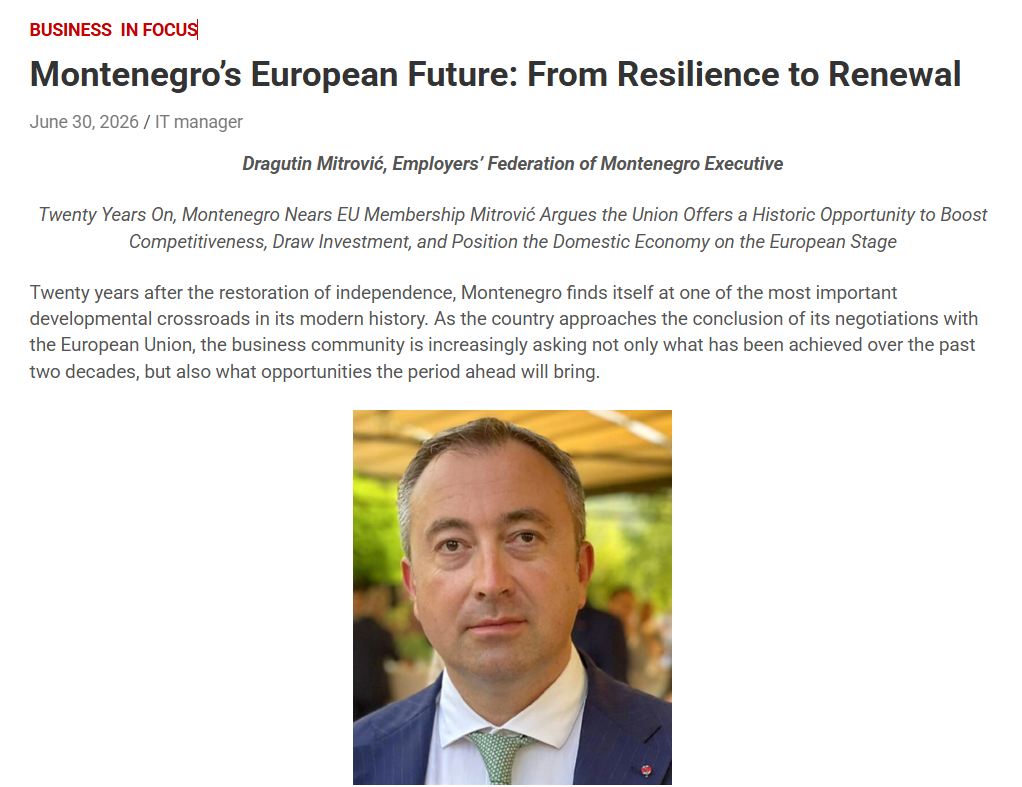
Entrepreneurs and business owners in Montenegro have shown remarkable resilience amid numerous challenges – from the global financial crisis to the COVID-19 pandemic to the political and economic transformations that have marked the region. Despite a limited market and numerous structural challenges, domestic companies have managed to preserve business continuity and ensure a stable supply of goods and services to citizens. However, as Dragutin Mitrović, member of the Executive Board of the Employers’ Federation of Montenegro, points out, the key challenge has not been a lack of entrepreneurial energy, but rather the absence of a clear developmental perspective.
“The period after 2014 was marked by a certain stagnation of European enlargement. When the prospect of membership became uncertain, a decline in business optimism and investment energy was felt. Today, the situation is different – the goal is clear once again, and that goal is Montenegro’s full membership in the European Union,” Mitrović told Diplomacy.
In his words, European integration represents far more than a political process. It means adopting standards that improve the business environment, strengthen legal certainty, and create the preconditions for long-term economic growth. “In closed systems, it is difficult to solve problems such as the grey economy, corruption, regulatory obstacles or the shortage of a qualified workforce. The European framework brings additional responsibility, but also mechanisms that help to overcome these challenges systemically,” Mitrović emphasises.
He considers it particularly significant that upon joining the European Union, Montenegro will become more visible on the map for European investors, media, and business partners.
THE BEST IS YET TO COME
In the words of Dragutin Mitrović, European Union membership represents an unprecedented developmental opportunity for the Montenegrin economy. By entering the single European market of more than 450 million consumers, domestic companies gain the chance for stronger growth, new partnerships and greater international recognition. “This opens up space for new investment, partnerships and the development of domestic enterprises. That is why I believe the best is yet to come.”
“More than 450 million inhabitants, and millions of companies and investors across the European Union, will for the first time view Montenegro as part of the common market. It opens up space for new investment, partnerships and the development of domestic enterprises. That is why I believe the best is yet to come,” Mitrović says.
Nevertheless, the Diplomacy interviewee believes that complete success also requires a change in the social paradigm. “The era of individual success must grow into an era of shared success. The state, the economy and citizens should act as a team. Montenegro’s European future is not the project of a single institution or a single generation – it is a common endeavour of us all,” Mitrović concludes.
It is precisely in this shift – from “I” to “we” – that many see the most important step towards Montenegro’s European future. If the past twenty years were a time of proving resilience, the coming decade could become a period of full affirmation of the country’s economic potential on the European stage.