
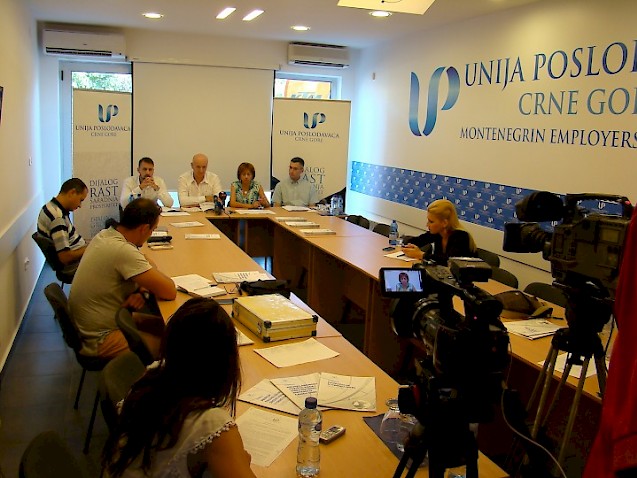
At today's media conference, MEF presented the three new strategic documents – MEF reports: (1) Access to Financial Resources in Montenegro, (2) Corruption in Montenegro and (3) Mismatch between Education and Labour Market Needs in Montenegro.
Thereby, representatives of media were addressed by Svetlana Vuksanovic, MEF President with members of the team of authors that participated in creation of the above listed reports: Predrag Drecun, Dr Jovan Djuraskovic and Edin Koljenovic.
MEF President, Svetlana Vuksanovic, pointed out that the aim of MEF with these reports was to offer a content that would additionally help the processes that had started in the country and would be of use in preparing the future policies and measures to support economic development, employment and economic growth. “Establishment of a stimulating business environment is a main precondition for proper business functioning, economic activities growth, preservation of current and creation of new jobs, stable and sustainable development in the long run. Real sector economy - the one that creates, employs, fills the state budget and is the driving force of Montenegro’s development, asks for special attention and unreserved support by policy and decision makers at all levels of governing. In MEF, we believe that it is high time that competent authorities realise that and act accordingly”, said Vuksanovic.
That difficult access to financial resources is one of the key problems for businesses was confirmed by the content of the first document presented. As pointed out therein, the current situation in our country is still unfavourable, although there has been a continuous progress in this field.
Predrag Drecun, a co-author of MEF report “Access to Financial Resources in Montenegro”, said: “The access to financial resources in our country is improving but still lags far behind the EU level. The fact that the state underpins the role of Investment Development Fund in providing direct financing to SME is encouraging. However, what remains a significant problem is the structure of foreign trade deficit as important generator of internal insolvency of the economy that provokes stronger demand for money by businesses.”
The second report presented deals with the mismatch between education and labour market needs that MEF recognised as one of the key business barriers. As co-authors of this report, MEF engaged Prof Dr Milivoje Radovic and Dr Jovan Djuraskovic.
Dr Jovan Djuraskovic, one of co-authors of MEF report “Mismatch between Education and Labour Market Needs in Montenegro” pointed out that the education system did not consider the needs of the labour market and added: “Quantity over quality contributed to rapid growth in number of university graduates leading to unemployment growth for this population. Insufficient specialisation of university programmes and education programmes in general secondary education creates low value knowledge. There is an overwhelming syndrome of “easier to diploma – harder to job”. It is therefore necessary to: improve cooperation and partnership between education institutions, public employment services and Montenegrin Employers Federation; develop practical training at all levels of education; concretise knowledge and skills; strengthen self-education and entrepreneurial learning. At enterprise level, it is necessary to develop a long-term oriented function of human resources development.”
Although corruption is perceived as one of the key reasons for bad economic state of a society, a co-author of MEF report on corruption explained that enterprises were not proactive enough and ready to fight it to the extent it is needed. The reason for such behaviour is insufficient knowledge of procedures and possibilities to report that kind of actions but also distrust that institutions will adequately act upon report.
Edin Koljenović, co-author of MEF report “Corruption in Montenegro” highlighted: “The level of corruption in Montenegrin society is worrying to the point it creates negative patterns of relations in everyday life, while certain sorts of corruptive actions leave serious consequences on business sector and economic results and can become a serious obstacle for private and foreign investments and overall development of trade and economy. Economic (business) consequences are numerous: corruption hinders safe and rational investments (both domestic and foreign), slows down the development and limits trade, leads to irrational and uneconomical use of public sources, encourages “grey” economy and narrows down tax sources.”
At the end of the conference, it was explained that the contents of the three new MEF reports were based on previously published MEF strategic document “5 business killers” as well as on the results of thematic survey carried out by MEF at the beginning of 2016. With these reports MEF continues the activities it has been realising with the support of International Labour Organisation since 2013 all aimed at creating business environment that will stimulate and encourage the development of sustainable enterprises in Montenegro. A special segment of MEF actions in this direction is the support to elimination of the most important business barriers that MEF identified back in its document 5 business killers: 1) inadequate regulatory framework, 2) difficult access to financial resources 3) informal economy, 4) corruption and 5) a mismatch between education and labour market needs.


